One of the biggest challenges business leaders face is getting employees to take ownership.
Deadlines get missed.
Managers keep following up.
Founders get pulled into daily decisions.
Teams wait for instructions instead of taking initiative.
As a result, many leaders start increasing supervision.
More check-ins.
More status meetings.
More approvals.
More monitoring.
The intention is good.
The outcome is usually the opposite.
The more leaders micromanage, the more dependent teams become.
Over time, organizations create a culture where employees work only when someone is watching.
This creates a critical question:
How do you build accountability without constantly monitoring people?
The answer lies in understanding the difference between accountability and micromanagement.
Accountability and Micromanagement Are Not the Same Thing
Many organizations mistakenly treat accountability and micromanagement as interchangeable concepts.
They are fundamentally different.
Micromanagement focuses on controlling activities.
Accountability focuses on achieving outcomes.
Micromanagement Asks
- Where are you right now?
- What are you doing?
- Why haven't you updated me?
Accountability Asks
- What outcome are you responsible for?
- What progress have you made?
- What support do you need?
One creates dependency.
The other creates ownership.
Organizations that fail to understand this distinction often end up with frustrated leaders and disengaged employees.
Why Leaders Start Micromanaging
Most leaders don't wake up intending to micromanage.
Micromanagement usually develops gradually.
It often begins when:
- Deadlines are missed
- Teams make mistakes
- Communication breaks down
- Performance becomes inconsistent
Leaders respond by increasing involvement.
They want visibility.
They want control.
They want assurance that things are moving forward.
While this may solve short-term problems, it creates long-term dependency.
Employees start relying on supervision instead of taking ownership.
The organization becomes slower and less scalable.
The Hidden Cost of Micromanagement
Micromanagement affects the business in ways many leaders fail to recognize.
Slower Decision-Making
Employees wait for approval before acting.
Lower Innovation
Teams become hesitant to experiment or contribute ideas.
Reduced Ownership
Individuals stop feeling responsible for outcomes.
Leadership Burnout
Managers spend excessive time following up on routine tasks.
Founder Dependency
Everything eventually escalates to senior leadership.
As organizations grow, these problems become increasingly expensive.
The business becomes reliant on management intervention rather than employee initiative.
👉 Related Read: Founder Dependency: The Biggest Threat to Sustainable Business Growth
Why Employees Avoid Ownership
Many leaders assume employees avoid responsibility because they lack motivation.
In reality, ownership problems are often system problems rather than people problems.
Employees struggle to take ownership when:
Expectations Are Unclear
People are unsure what success looks like.
Decision-Making Authority Is Missing
Employees are expected to deliver results without the power to make decisions.
Accountability Is Inconsistent
Different standards apply to different people.
Mistakes Are Punished Excessively
Employees avoid initiative because they fear consequences.
When these conditions exist, ownership naturally declines.
The solution is not more supervision.
The solution is better leadership systems.
Accountability Starts With Clarity
People cannot be accountable for outcomes they do not understand.
One of the most effective ways to improve accountability is to create clarity.
Employees should know:
- What they are responsible for
- What success looks like
- How results will be measured
- What decisions they can make independently
Without clarity, teams become dependent on constant direction.
With clarity, they become capable of self-management.
Accountability grows when expectations become visible.
The Difference Between Accountability and Control
A useful way to understand accountability is to compare it directly with control.
Many businesses think they are creating accountability when they are actually creating control.
Long-term growth requires shifting from supervision to ownership.
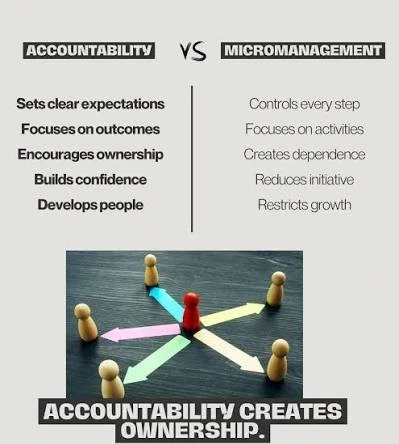
| Accountability | Micromanagement |
|---|---|
| Focus on outcomes | Focus on activities |
| Builds ownership | Builds dependency |
| Encourages initiative | Discourages initiative |
| Creates leaders | Creates followers |
| Promotes trust | Promotes supervision |
| Supports growth | Limits scalability |
How High-Performing Companies Build Accountability
Organizations known for strong execution rarely rely on heavy supervision.
Instead, they create systems that support accountability naturally.
Clear Expectations
Employees know exactly what is expected.
Visible Metrics
Performance is measurable and transparent.
Regular Reviews
Progress is discussed consistently.
Coaching Conversations
Managers help people improve instead of simply monitoring them.
Decision-Making Authority
Teams have the ability to solve problems independently.
Consistent Consequences
Strong performance is recognized and poor performance is addressed fairly.
Together, these elements create an ownership culture.
Signs Your Organization Has an Accountability Problem
Many accountability issues reveal themselves through common symptoms.
Examples include:
- Constant follow-up requirements
- Missed deadlines
- Frequent escalations
- Lack of ownership during meetings
- Dependency on founders
- Blame-shifting between teams
- Repeated reminders for the same tasks
If these issues occur regularly, the organization may be experiencing an accountability gap rather than a performance gap.
The distinction is important because the solutions are different.
How Leaders Can Build Ownership Culture
Creating accountability requires deliberate effort.
Leaders can begin by focusing on several key practices.
Stop Solving Every Problem
Encourage employees to propose solutions instead of immediately escalating issues.
Delegate Outcomes, Not Just Tasks
Give people responsibility for results rather than individual activities.
Ask Better Questions
Instead of asking for updates constantly, ask about their plan, obstacles and support needed.
Create Visibility
Make goals and progress transparent.
Reward Ownership
Recognize employees who take initiative and deliver outcomes.
Over time, these behaviors encourage self-management and accountability.
Why Accountability Is Essential for Business Growth
As businesses grow, leaders cannot manage every activity personally.
More customers.
More employees.
More projects.
More complexity.
Growth requires distributed ownership.
Organizations that rely heavily on supervision eventually hit scalability limits.
Organizations with strong accountability systems become more agile, efficient and resilient.
Accountability is not just a management practice.
It is a growth strategy.
How SIL Helps Organizations Build Accountability
At SIL, we help organizations create strong accountability systems that improve execution without increasing bureaucracy.
Our approach focuses on building leadership capability, ownership culture and execution discipline.
Our support includes:
Business Consulting
Corporate Training
Macro Planning
Business Outsourcing
Leadership Development
Building leaders who drive ownership rather than supervision.
Accountability Frameworks
Practical systems that build ownership without added bureaucracy.
Performance Management Systems
Bringing visibility and structure to how performance is tracked and reviewed.
Organizational Alignment
Aligning teams, roles and structure around a shared direction.
We help organizations move from supervision-driven execution to ownership-driven performance.
Final Thoughts
Many leaders believe accountability requires constant monitoring.
The opposite is often true.
The strongest accountability cultures are built on clarity, ownership and trust rather than supervision.
Micromanagement may create short-term control.
Accountability creates long-term performance.
The organizations that scale successfully are rarely those with leaders who control everything.
They are the organizations where employees take ownership, make decisions and deliver results without waiting to be told what to do.
Because ultimately, great businesses are not built through oversight alone.
They are built through ownership.