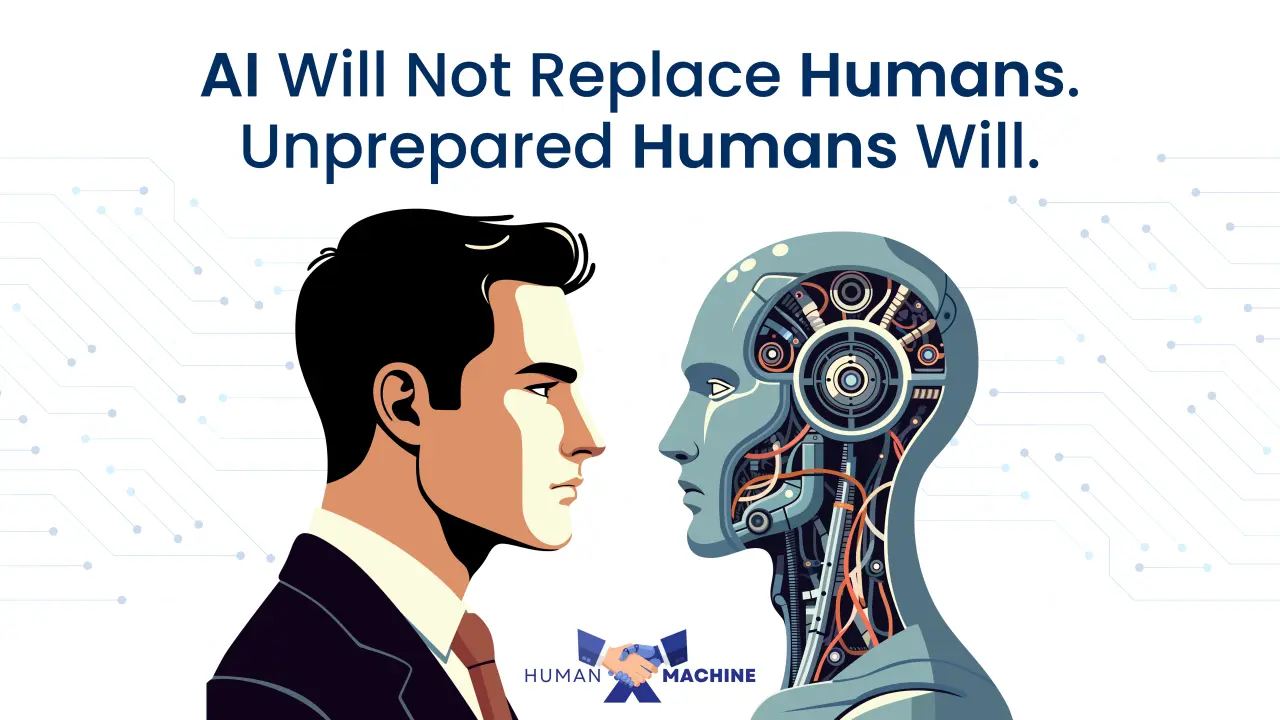
The conversation around Artificial Intelligence often starts with fear.
Will AI replace employees?
Will AI eliminate jobs?
Will humans become less relevant?
While these questions continue to dominate headlines, they often distract business leaders from a far more important reality.
AI is not replacing leadership.
In fact, the AI era is making leadership more important than ever before.
What AI is doing, however, is exposing weak leadership.
Businesses that rely on outdated management styles, slow decision-making and poor execution systems will struggle to compete.
Organizations led by adaptable, strategic and forward-thinking leaders will move faster, make better decisions and create stronger businesses.
The future is not a competition between humans and AI.
It is a competition between leaders who evolve and leaders who don't.
Every Major Business Shift Has Changed Leadership
History shows that every major technological transformation changes how businesses operate.
The internet changed communication.
Cloud computing changed technology infrastructure.
Mobile technology changed customer behavior.
Artificial Intelligence is now changing how information is processed, analyzed and applied.
However, none of these innovations eliminated the need for leadership.
Instead, they increased the need for leaders capable of guiding organizations through change.
Businesses that adapted grew.
Businesses that resisted were left behind.
AI is no different.
What AI Is Exceptional At
Artificial Intelligence is remarkably effective at:
- Processing large amounts of information
- Identifying patterns
- Automating repetitive tasks
- Generating reports
- Drafting content
- Supporting analysis
These capabilities create enormous opportunities for organizations.
However, access to information is no longer the competitive advantage it once was.
Today, almost anyone can access insights, data and recommendations.
This changes the value equation.
When information becomes easier to obtain, decision-making becomes more valuable.
And decision-making remains a leadership capability.
What AI Cannot Replace
While AI can generate recommendations, it cannot replace several critical leadership responsibilities.
Vision
Organizations need leaders to define direction and priorities.
Judgment
Business decisions often involve ambiguity, trade-offs and risk.
Accountability
Technology can suggest actions, but leaders remain responsible for outcomes.
Relationship Building
Trust, influence and organizational alignment remain deeply human capabilities.
Culture Creation
AI can automate tasks. It cannot create a culture of ownership, accountability and performance.
These responsibilities belong to leaders.
Why Weak Leadership Becomes More Visible in the AI Era
Many organizations currently operate with leadership habits that developed in a different business environment.
Examples include:
- Micromanagement
- Information hoarding
- Decision delays
- Excessive hierarchy
- Lack of accountability
In the past, these issues could often remain hidden.
The speed of business was slower.
Information moved more slowly.
Decision cycles were longer.
AI accelerates everything.
This means leadership weaknesses become visible much faster.
Organizations that cannot adapt will struggle to maintain competitiveness.
The New Advantage Is Not Information. It Is Interpretation.
For decades, leadership was often associated with access to information.
Leaders knew more than everyone else.
Today, AI is rapidly changing that reality.
Information is becoming abundant.
Insights are becoming more accessible.
Reports can be generated instantly.
As a result, leadership is shifting from information ownership to information interpretation.
Strong leaders will be those who can:
- Ask better questions
- Evaluate context
- Make strategic choices
- Align teams around decisions
- Execute effectively
The leader who interprets information effectively will outperform the leader who simply possesses information.
Why Strategic Thinking Becomes More Valuable
As AI handles more analytical work, strategic thinking becomes increasingly valuable.
Business leaders must focus on:
- Long-term direction
- Market opportunities
- Competitive positioning
- Resource allocation
- Organizational capability
These responsibilities cannot be outsourced to technology.
AI can support strategy.
It cannot own strategy.
The ability to think clearly under uncertainty remains a defining leadership skill.
The Shift From Managing Tasks to Leading Change
Many managers have traditionally focused on supervising work.
The AI era requires something different.
Organizations need leaders who can:
- Navigate transformation
- Drive adoption
- Manage uncertainty
- Build alignment
- Lead cultural change
The leader's role is becoming less about monitoring activity and more about creating adaptability.
Businesses that embrace this shift will create stronger teams and faster execution.
The Skills That Will Define Future Leaders
In the AI era, several leadership skills become increasingly important.
Strategic Thinking
Seeing opportunities beyond immediate challenges.
Decision-Making
Making choices despite uncertainty.
Adaptability
Responding effectively to rapid change.
Communication
Helping teams understand direction and priorities.
Coaching and Development
Helping employees evolve alongside technology.
Systems Thinking
Understanding how multiple factors interact within a business.
Organizations that invest in developing these capabilities will build stronger leadership pipelines.
Why AI Increases the Importance of Human Leadership
Ironically, the more technology advances, the more important human leadership becomes.
Technology can increase efficiency.
Leadership creates purpose.
Technology can generate options.
Leadership makes choices.
Technology can automate workflows.
Leadership builds organizations.
This is why AI is unlikely to reduce the importance of leadership.
It will increase it.
How SIL Helps Leaders Thrive in the AI Era
At SIL, we believe the future belongs to organizations that combine technological capability with strong leadership.
We work with founders, leaders and organizations to help them build:
Leadership Development Programs
Business Consulting
Macro Planning
Organizational Alignment
Aligning teams, roles and structure around a shared direction.
Accountability Systems
Building clarity around ownership and outcomes.
Business Scalability Frameworks
Preparing organizations and leaders to grow sustainably.
The objective is not simply preparing for AI.
It is preparing leaders to succeed because of it.
Final Thoughts
Artificial Intelligence will transform how businesses operate.
There is little doubt about that.
However, technology alone will not determine which organizations succeed.
Leadership will.
The leaders who embrace learning, adaptability and strategic thinking will create stronger organizations than ever before.
The leaders who cling to outdated management approaches will struggle to remain relevant.
Because the future is not about AI replacing leaders.
It is about stronger leaders replacing weaker ones.