Introduction
In 2026, supply chain management is no longer just about moving goods from point A to point B. It is about cash flow, customer experience, execution discipline, and business scalability.
Many businesses today don’t fail because of weak demand — they struggle because their supply chains are fragmented, reactive, and dependent on individuals instead of systems.
At SIL, we see supply chain management as a business capability, not just an operational function. When done right, it becomes a strategic advantage. When done poorly, it quietly erodes margins, delays growth, and overwhelms leadership.
What Is Supply Chain Management?
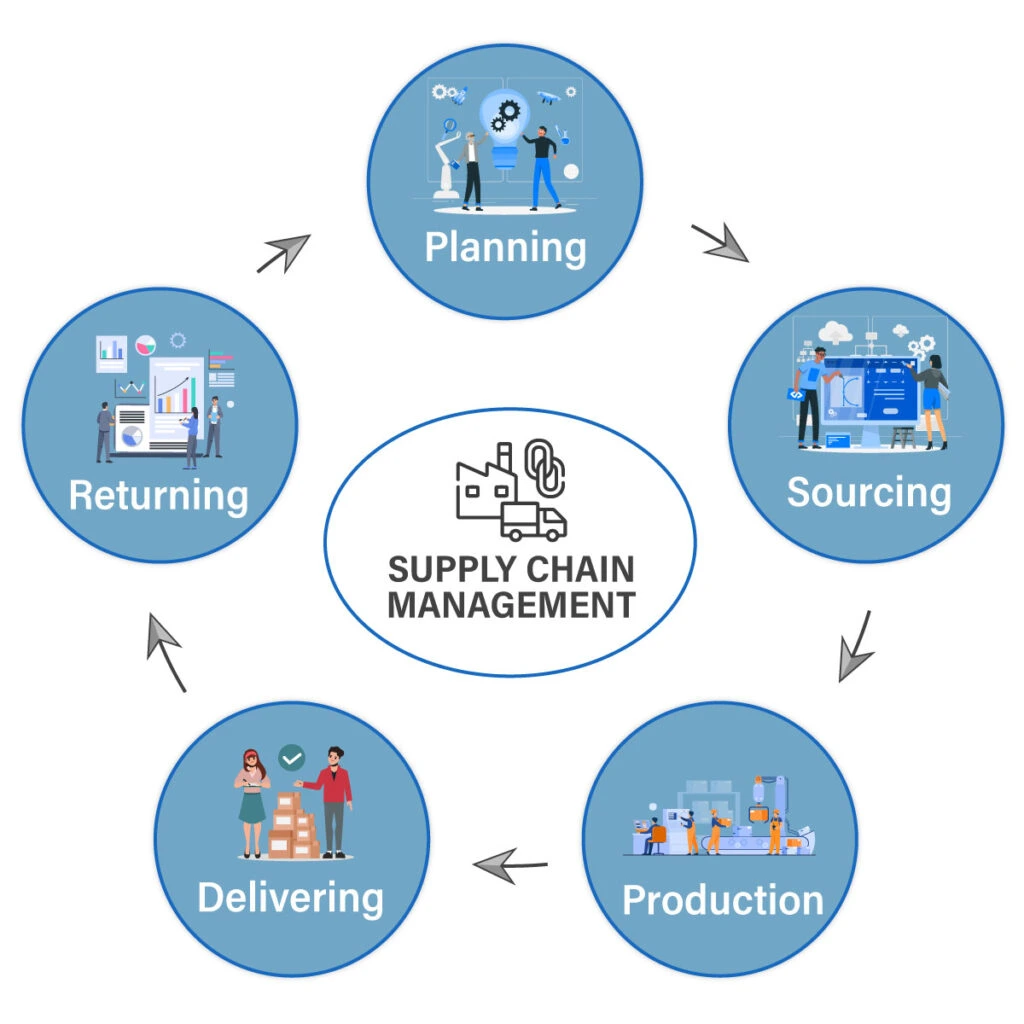
Supply Chain Management (SCM) is the structured coordination of all activities involved in:
- Demand planning
- Procurement and vendor management
- Inventory management
- Warehousing
- Logistics and distribution
- Performance measurement and control
The goal of supply chain management is simple: Deliver the right product, at the right time, in the right quantity, at the lowest sustainable cost — without chaos.
For growing businesses, supply chain management is not just about efficiency — it is about predictability and control.
Why Supply Chain Management Matters More in 2026
- Cost pressures are higher than ever
Rising input costs, logistics volatility, and working capital pressure mean businesses can no longer afford excess inventory or inefficient logistics.
A well-designed supply chain directly improves gross margins, cash flow, inventory turns. - Customers expect reliability, not excuses
Late deliveries, inconsistent service levels, and stock-outs damage trust. Modern supply chain management aligns planning, inventory, and execution so customer commitments are realistic and repeatable. - Growth exposes weak supply chains
As businesses scale: informal vendor relationships break, manual planning stops working, founder-driven decision-making becomes a bottleneck.
Supply chain management creates systems that scale, not firefighting.
Core Components of Effective Supply Chain Management
- Demand Planning & Forecasting
Demand planning aligns sales expectations with supply realities. Without it, businesses either overstock (blocking cash), or understock (losing sales).
At SIL, demand planning is treated as a cross-functional discipline, not just a spreadsheet exercise. - Procurement & Vendor Management
Strong supply chains are built on reliable vendors and structured procurement processes. Key elements include vendor evaluation and rationalization, clear procurement policies, performance tracking (cost, quality, reliability). - Inventory Management
Inventory is often the largest cash lock-up in a business. Effective inventory management focuses on inventory classification, reorder logic and safety stock, demand-linked replenishment, visibility across locations. - Logistics & Distribution
Logistics costs quietly erode margins when unmanaged. Supply chain management improves logistics by optimizing routes and distribution models, improving coordination with logistics partners, balancing cost vs service levels. - Warehousing & Fulfillment
Warehouses are execution engines. Poor layout, unclear processes, and weak controls slow everything down. Well-managed warehousing improves order accuracy, dispatch speed, inventory visibility. - Supply Chain Performance Management
What is not measured cannot be controlled. Key supply chain KPIs typically include inventory turns, order fulfillment rate, logistics cost as % of sales, vendor reliability, cycle time.
Supply Chain Management for SMEs vs Enterprises
SMEs
Common challenges: founder-driven purchasing decisions, weak forecasting, no formal SOPs, poor visibility.
SMEs benefit most from basic structure, clarity, and discipline — not complexity.
Enterprises
Common challenges: siloed functions, slow decision-making, bloated processes, poor cross-functional coordination.
Enterprises benefit from process simplification, governance, and execution alignment.
How SIL Approaches Supply Chain Management Consulting
At SIL, supply chain management is approached as a business transformation initiative, not a technical project.
- Step 1: Supply Chain Diagnostic
We assess demand–supply alignment, inventory health, vendor performance, logistics efficiency, execution gaps. - Step 2: Supply Chain Design & Optimization
We redesign planning processes, procurement and vendor systems, inventory logic, logistics and warehousing models. - Step 3: Implementation & Execution Support
SIL works with teams to implement SOPs, define ownership and KPIs, establish governance and review cadence. - Step 4: Performance Tracking & Stabilization
We ensure improvements are measurable, repeatable, and sustainable.
Common Supply Chain Mistakes Businesses Make
- Treating supply chain as a cost center
In reality, supply chain decisions directly impact revenue, margins, and customer experience. - Optimizing one function in isolation
Inventory, procurement, and logistics must be optimized together, not separately. - Over-relying on tools without process clarity
Software cannot fix unclear processes or weak ownership.
When Should a Business Invest in Supply Chain Management?
You likely need structured supply chain management if:
- inventory levels feel “out of control”
- logistics costs keep increasing
- deliveries are inconsistent
- vendors are unreliable
- leadership spends too much time firefighting
At this stage, supply chain management becomes a growth enabler, not an operational fix.
The Business Impact of Strong Supply Chain Management
Organizations with well-managed supply chains typically experience:
- improved cash flow
- lower operational costs
- better service levels
- faster scalability
- reduced leadership dependency
Final Thoughts
In 2026, supply chain management is no longer optional. It is a core business capability that determines whether a company can scale profitably and predictably.
At SIL, we help businesses build structured, resilient, and scalable supply chains that support long-term growth — not just day-to-day operations.