Introduction
In 2026, most businesses aren’t losing money because they lack strategy. They lose money because their processes don’t scale.
Sales handovers break. Procurement approvals slow down. Customer support gets inconsistent. Finance reports arrive late. Leaders step in to “fix” issues—until the business becomes dependent on individuals rather than systems.
That’s exactly where Business Process Consulting becomes a competitive advantage.
Business process consulting helps organizations understand how work is currently being done, identify what’s slowing performance, and redesign processes so teams can execute faster, with better quality, and at lower cost—without increasing chaos.
What is Business Process Consulting?
Business Process Consulting is a structured service that helps an organization:
- Map how work actually happens today
- Find bottlenecks, waste, rework, and control gaps
- Redesign workflows for speed, clarity, and accountability
- Implement improvements with governance and measurement
- Sustain performance through KPIs, SOPs, and continuous improvement
A business process consultant is typically engaged to improve internal workflows and make them repeatable and scalable.
Business Process Consulting vs BPM vs Automation
These terms are often confused:
- Business Process Consulting = improvement project + redesign + implementation support
- Business Process Management (BPM) = the ongoing discipline of designing, executing, monitoring, and optimizing processes over time
- Automation / Hyperautomation = using tools (RPA, AI, workflow platforms) to automate steps inside processes—usually after the process is clarified
In simple terms: Consulting fixes the process. BPM governs it. Automation accelerates it.
Why Business Process Consulting Matters More in 2026
- AI is amplifying process problems (not hiding them)
AI tools can boost productivity—but only when the underlying process is clean. If your process is unclear, AI often automates confusion at scale. - Leaders want speed without losing control
In fast-moving markets, companies need faster decisions, shorter cycle times, fewer escalations, predictable outputs. - Data-driven process improvement is now practical
In 2026, many organizations use process mining, which analyzes event logs from systems (ERP/CRM) to show how processes actually flow in reality.
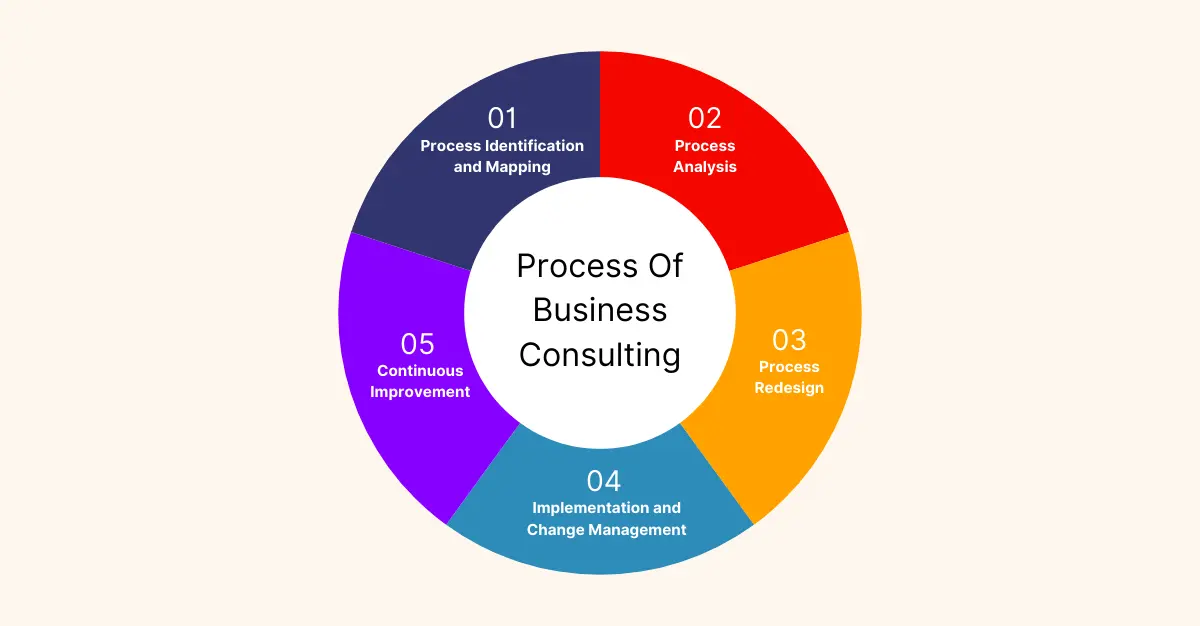
What Business Process Consultants Actually Do
1. Process Discovery and Mapping
… As-Is process map, Stakeholder map, Issue list (bottlenecks, delays, rework points)
2. Root Cause Analysis
Common root causes: unclear ownership, too many approvals, duplicated data entry, broken handoffs, missing SOPs, metrics that measure activity not outcome
3. Process Redesign (To-Be)
… To-Be process map, SOPs / playbooks, RACI, Control points + risk checks
4. Implementation & Change Enablement
piloting, training, governance cadence, performance dashboards
5. Measurement and Continuous Improvement
cycle time, cost per transaction, first-time-right rate, rework rate, SLA adherence, customer NPS / complaint rate