Artificial Intelligence has rapidly become one of the most talked-about business opportunities in recent years.
From startups and MSMEs to global enterprises, organizations everywhere are exploring how AI can improve productivity, reduce costs and accelerate growth.
Business leaders are attending webinars, purchasing AI subscriptions, experimenting with new tools and encouraging teams to “start using AI.”
Yet despite all this activity, many organizations are struggling to achieve meaningful results.
The problem is not a lack of technology.
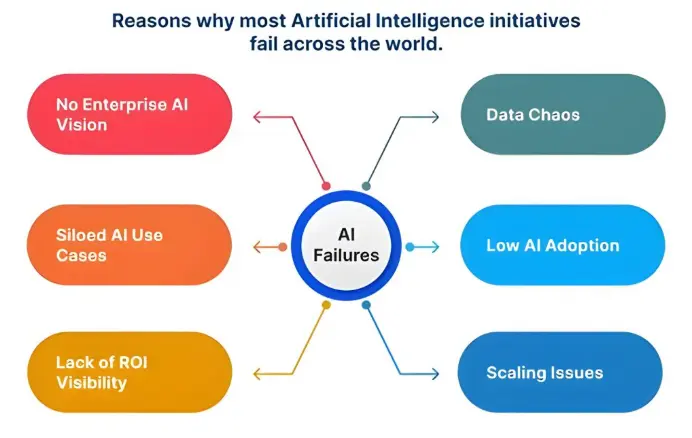
The problem is that most AI failures have very little to do with AI itself.
They are usually leadership failures, process failures or organizational readiness failures.
Many businesses are approaching AI as a technology project when it is actually a business transformation initiative.
And that distinction often determines whether AI becomes a competitive advantage or an expensive disappointment.
Most Businesses Start With Tools Instead of Problems
One of the most common mistakes organizations make is becoming obsessed with AI tools before understanding the business problems they are trying to solve.
Leaders often ask:
- Which AI software should we buy?
- What AI platform are competitors using?
- Which subscription should we invest in?
Unfortunately, these questions are being asked before a more important question:
What business challenge are we trying to solve?
Successful AI adoption always starts with a business problem.
Perhaps your sales team spends hours creating proposals.
Maybe managers spend too much time preparing reports.
Perhaps customer service teams are overwhelmed with repetitive queries.
These are business challenges.
AI becomes valuable only when it helps solve them.
Organizations that chase technology without identifying clear business opportunities often end up with low adoption, minimal impact and frustrated teams.
AI Cannot Fix Broken Processes
Many organizations treat AI as a shortcut to operational excellence.
Unfortunately, technology cannot compensate for poorly designed systems.
If your workflows are already inefficient, introducing AI may simply automate inefficiency.
Consider an organization with unclear approval processes, inconsistent reporting standards and poor communication between departments.
Adding AI to this environment rarely creates transformation.
Instead, it often creates new complexity.
Before implementing AI, businesses should first ask:
- Are our processes clearly defined?
- Do we have accountability?
- Is ownership visible?
- Are decision-making structures working?
Strong processes amplify the value of AI.
Weak processes magnify confusion.
This is why many organizations fail to see meaningful returns despite investing heavily in technology.
Employees Are Often Excluded From AI Conversations
Many AI initiatives are designed exclusively by leadership teams.
Employees are informed after decisions have already been made.
This often creates resistance.
People immediately begin asking:
- Will AI replace my role?
- Why is the business implementing this?
- How does this affect my future?
When these questions remain unanswered, fear begins replacing curiosity.
Employees may avoid using the new tools or adopt them only superficially.
The most successful organizations take a different approach.
They involve employees early.
They explain the purpose of AI initiatives.
They focus on how technology can remove repetitive work rather than eliminate human value.
When people understand the benefits, adoption improves significantly.
👉 Related Read: How MSMEs Can Use AI Without Replacing Their Teams
Many Leaders Underestimate the Importance of Change Management
Organizations often spend months evaluating technology but very little time preparing people.
This is one of the biggest reasons AI initiatives fail.
Technology changes quickly.
Human behavior does not.
AI adoption requires:
- New habits
- New workflows
- New responsibilities
- New ways of thinking
Without structured change management, organizations struggle to move from implementation to adoption.
Employees may have access to sophisticated tools but continue working exactly as they did before.
The result is an expensive system with limited business impact.
True transformation occurs when people change how they work, not when software is installed.
Businesses Focus Too Much on Automation and Too Little on Capability
Another common mistake is viewing AI exclusively as an automation tool.
While automation creates value, it represents only one part of the opportunity.
The highest-performing organizations use AI to enhance human capability.
For example:
Sales
A sales professional uses AI to prepare proposals faster.
Management
A manager uses AI to summarize data for decision-making.
Marketing
A marketing team uses AI to accelerate content creation.
In each case, AI improves human performance rather than replacing it.
Businesses that focus solely on reducing effort often miss the larger opportunity to increase capability, productivity and innovation.
Leadership Alignment Often Determines Success
AI initiatives frequently struggle because leadership teams are not fully aligned.
Different stakeholders have different expectations.
Some leaders want cost reduction.
Others expect revenue growth.
Others focus on productivity improvements.
Without alignment, organizations pursue conflicting goals.
Employees receive mixed messages.
Projects lose momentum.
Resources become fragmented.
Successful AI adoption requires leadership teams to share a common vision.
Everyone should understand:
- Why AI is being implemented
- What success looks like
- How outcomes will be measured
Without this clarity, even strong technology investments can fail to produce results.
The Organizations Winning With AI Focus on Readiness
Businesses that achieve meaningful value from AI tend to share similar characteristics.
They focus less on technology and more on readiness.
They invest in:
Leadership Awareness
Helping leaders understand both opportunities and limitations.
Employee Education
Building confidence and capability across teams.
Process Improvement
Ensuring workflows support AI adoption.
Accountability
Creating ownership around outcomes.
Continuous Learning
Encouraging experimentation and adaptation.
These organizations view AI as part of a broader transformation strategy rather than a standalone technology purchase.
👉 Related Read: How to Build an AI-Ready Organization
AI Success Is More About Culture Than Technology
This may surprise many business leaders.
The organizations creating the greatest value from AI are not necessarily the ones with the most advanced technology.
They are often the ones with the strongest learning cultures.
These organizations encourage:
- Curiosity
- Experimentation
- Problem-solving
- Continuous improvement
- Collaboration
Employees feel comfortable testing new approaches and sharing lessons learned.
Leadership supports innovation instead of demanding immediate perfection.
Over time, this culture becomes a competitive advantage.
Organizations learn faster.
And organizations that learn faster often outperform organizations that simply spend more.
How SIL Helps Businesses Build Successful AI Transformation Strategies
At SIL, we believe AI adoption should begin with business readiness rather than technology selection.
We help organizations prepare their people, leadership teams and operational systems for successful transformation.
Our support includes:
Business Consulting
Corporate Training
Leadership Development
Building leaders who align people, processes and technology.
Macro Planning
Business Process Improvement
Strengthening workflows so technology amplifies value instead of confusion.
Accountability Frameworks
Creating clarity around decision-making and ownership.
Organizational Alignment
Aligning teams, roles and structure around a shared direction.
Business Scalability Programs
Preparing organizations to grow sustainably alongside technology.
The goal is not simply implementing AI.
The goal is building an organization capable of generating value from AI consistently and sustainably.
Final Thoughts
AI is unlikely to fail because the technology is ineffective.
More often, AI fails because organizations are unprepared.
They focus on tools instead of problems.
Technology instead of people.
Implementation instead of adoption.
The businesses that create lasting value from AI understand a simple principle:
Technology does not create transformation.
People do.
AI is simply a tool.
The real competitive advantage comes from leaders who can align people, processes and technology toward a common goal.
And that is why successful AI adoption is ultimately a leadership challenge, not a technology challenge.