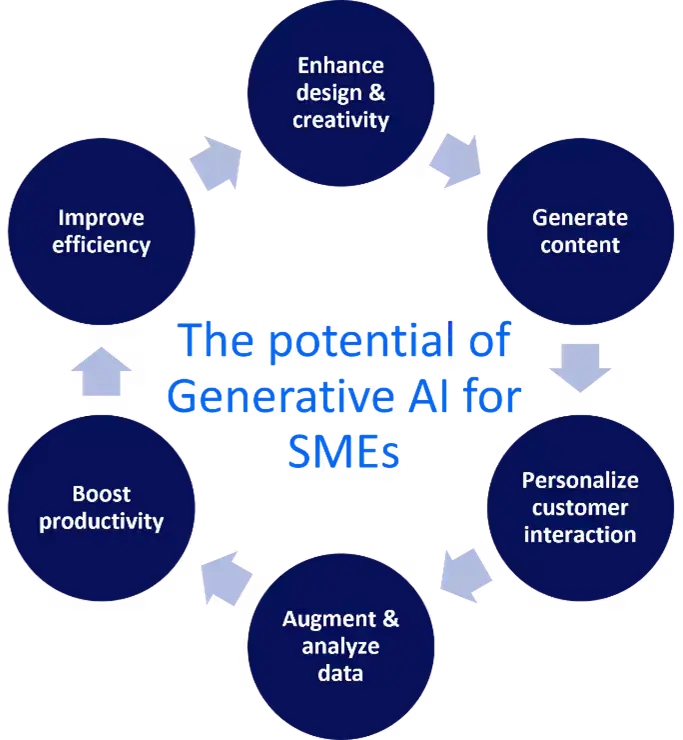
Artificial Intelligence (AI) is no longer reserved for large enterprises with massive technology budgets.
Today, AI tools are helping small and medium-sized businesses automate repetitive tasks, improve decision-making, enhance customer experiences, and increase profitability. Businesses that adopt AI strategically are gaining significant competitive advantages, while those that delay risk falling behind.
For SME owners, the question is no longer whether AI will impact their business. The real question is:
“How can we use AI to grow faster without increasing costs?”
This article explores practical AI applications that can help business owners boost productivity and build scalable organizations.
Why SMEs Should Pay Attention to AI
Most businesses face similar challenges:
- Limited manpower
- Increasing operational costs
- Founder dependency
- Slow decision-making
- Inconsistent customer experiences
AI can help solve many of these challenges by automating routine activities and providing valuable business insights.
Before implementing AI tools, businesses should align technology initiatives with their overall growth strategy using a structured Macro Planning Framework and leadership roadmap.
1. Automate Customer Support
Many SMEs spend significant time responding to repetitive customer queries.
AI-powered chatbots can:
- Answer FAQs
- Schedule appointments
- Capture leads
- Provide order updates
- Support customers 24/7
Benefits include:
- Faster response times
- Better customer experience
- Reduced workload for teams
Businesses undergoing Business Consulting often identify customer support automation as one of the quickest productivity wins.
2. Improve Lead Generation
Finding quality leads is one of the biggest challenges for growing companies.
AI tools can help:
- Identify ideal customer profiles
- Score leads automatically
- Predict conversion likelihood
- Personalize outreach campaigns
This enables sales teams to focus on high-value opportunities.
Organizations aiming to scale revenue should combine AI implementation with structured Business Growth Consulting methodologies to maximize results.
3. Strengthen Sales Forecasting
Many SMEs still rely on intuition when forecasting sales.
AI can analyze:
- Historical sales data
- Market trends
- Customer behavior
- Seasonal patterns
This leads to more accurate forecasts and better business planning.
When supported by effective Macro Planning processes, forecasting becomes a powerful strategic advantage.
4. Reduce Founder Dependency
Many business owners become bottlenecks because critical information remains centralized.
AI-powered dashboards can provide:
- Performance reports
- Revenue insights
- Operational metrics
- Customer analytics
As information becomes accessible across the organization, leadership teams make faster and more informed decisions.
This complements leadership development initiatives often implemented through Corporate Training Programs.
5. Enhance Employee Productivity
Employees spend countless hours on repetitive tasks such as:
- Data entry
- Email drafting
- Report generation
- Meeting summaries
AI tools can automate these activities, allowing employees to focus on higher-value responsibilities.
The result:
- Higher productivity
- Better employee engagement
- Faster execution
6. Improve Recruitment Efficiency
Hiring the right people remains a challenge for many SMEs.
AI can help:
- Screen resumes
- Rank candidates
- Schedule interviews
- Identify skill matches
This reduces hiring time while improving recruitment quality.
Companies looking to build stronger teams often combine recruitment improvements with Leadership Development Solutions to create future-ready organizations.
7. Create Better Marketing Content
Marketing teams can use AI for:
- Blog outlines
- SEO research
- Social media ideas
- Email campaigns
- Content optimization
However, AI should support human creativity, not replace it.
Well-structured content remains critical for building authority and generating inbound leads.
8. Improve Customer Retention
Acquiring customers is expensive.
Retaining them is more profitable.
AI helps businesses identify:
- Churn risks
- Customer satisfaction patterns
- Purchase behavior
- Upselling opportunities
Businesses can then proactively engage customers before issues escalate.
9. Streamline Business Operations
Many operational inefficiencies remain hidden until businesses start scaling.
AI can identify:
- Process bottlenecks
- Workflow delays
- Resource allocation issues
- Productivity gaps
Organizations focused on operational excellence often leverage Business Consulting Services to identify opportunities where AI can create measurable impact.
10. Support Better Decision-Making
One of AI's greatest strengths is transforming data into actionable insights.
Instead of relying solely on intuition, business leaders can use AI to evaluate:
- Revenue trends
- Customer behavior
- Employee performance
- Operational performance
Better data often leads to better decisions.
11. Improve Financial Planning
AI tools can support:
- Cash-flow forecasting
- Budgeting
- Expense analysis
- Profitability tracking
This gives leadership teams greater visibility into financial performance.
When combined with strategic Macro Planning, financial planning becomes more accurate and predictable.
12. Increase Team Accountability
Many businesses struggle with accountability because performance data is difficult to access.
AI dashboards can:
- Track KPIs
- Measure progress
- Generate reports
- Highlight performance trends
This creates greater ownership and transparency across the organization.
13. Identify New Growth Opportunities
AI tools can analyze:
- Industry trends
- Competitor activity
- Customer preferences
- Market demand
This helps businesses identify emerging opportunities faster.
Many successful scale-up companies proactively combine these insights with strategic guidance from Business Consulting Experts.
14. Enhance Leadership Effectiveness
Leaders need information quickly.
AI can support leaders by:
- Summarizing reports
- Highlighting trends
- Automating reviews
- Providing recommendations
As a result, leaders spend less time gathering information and more time driving business growth.
Organizations committed to developing future leaders often support these efforts through Corporate Training Programs.
15. Build a Scalable Business
Ultimately, AI should not be viewed as a technology initiative.
It should be viewed as a business growth initiative.
The goal is to build:
- Better systems
- Better processes
- Better decisions
- Better customer experiences
Businesses that integrate AI strategically often create more scalable organizations with stronger competitive advantages.
Common AI Mistakes SMEs Should Avoid
Trying Too Many Tools at Once
Start with one or two high-impact use cases.
Implementing AI Without Strategy
Technology should support business goals.
Ignoring Employee Adoption
Successful implementation requires team buy-in.
Expecting AI to Solve Every Problem
AI amplifies good processes. It does not replace them.
Focusing Only on Cost Savings
The biggest value often comes from growth and productivity improvements.
Conclusion
Artificial Intelligence is rapidly becoming a competitive necessity for SMEs.
Businesses that use AI strategically can improve productivity, enhance customer satisfaction, reduce costs, strengthen leadership effectiveness, and create scalable growth systems.
However, technology alone does not create transformation.
Sustainable results occur when AI is aligned with clear business objectives, leadership capability, operational excellence, and long-term strategy.
If your organization is exploring growth opportunities, SIL's Business Consulting, Macro Planning, and Corporate Training Solutions can help create a practical roadmap for leveraging AI and scaling your business effectively.